
Foundations
Architecture first
Separate AI service, queue workers and a vector store designed up front, so the product could scale without a rewrite.
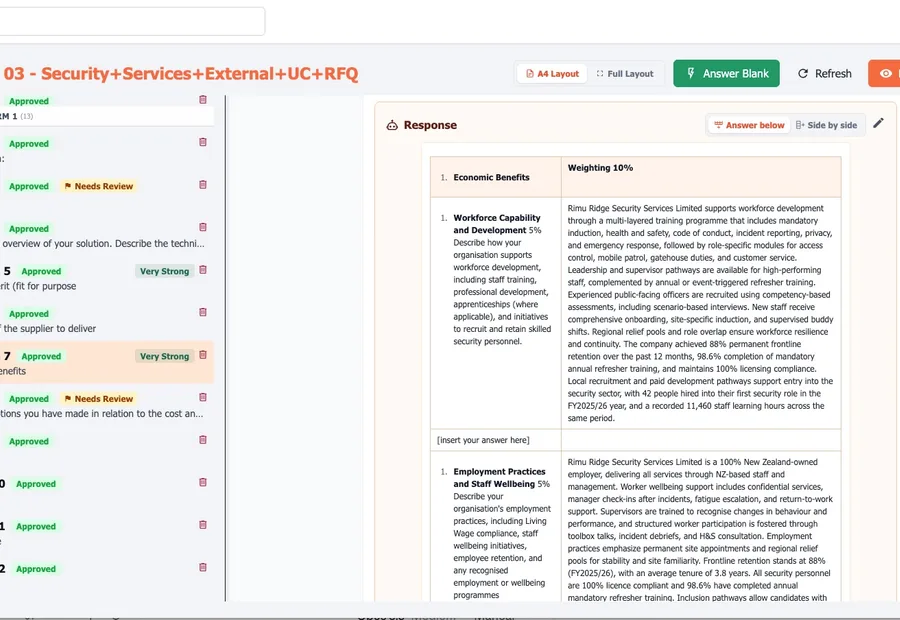
Responding to RFPs is slow, repetitive and high stakes. TendIT reads the documents, finds the questions and drafts grounded answers, then scores how good they are.
The problem
Bid teams rewrite the same answers for every RFP, and quality depends on who is available that week. The founder wanted a system that reads the tender, pulls the right material from the company's own documents and drafts a first answer worth editing.
Technology
Retrieval-augmented generation. Tender documents and the client's knowledge base are embedded into a vector database. OpenAI GPT models extract the questions and draft answers grounded in that material, and an evaluation pipeline scores answer quality so the team can see what needs a human.
How we worked
Foundations
Separate AI service, queue workers and a vector store designed up front, so the product could scale without a rewrite.
Blocks
Question extraction first, then grounded drafting, then quality scoring. Each reviewed live on real tenders.
Now
A monthly release rhythm, with the evaluation pipeline guiding what to improve next.
Where it is now
In use on real tenders, with new releases every month.
Talk to us about an AI productStart with a Blueprint: 3 to 5 days, and a plain go or no-go call at the end.